vendredi 1 novembre 2013

RETICELLO - PUNTO ANTICO - Giuliana Buonpadre (2/5)


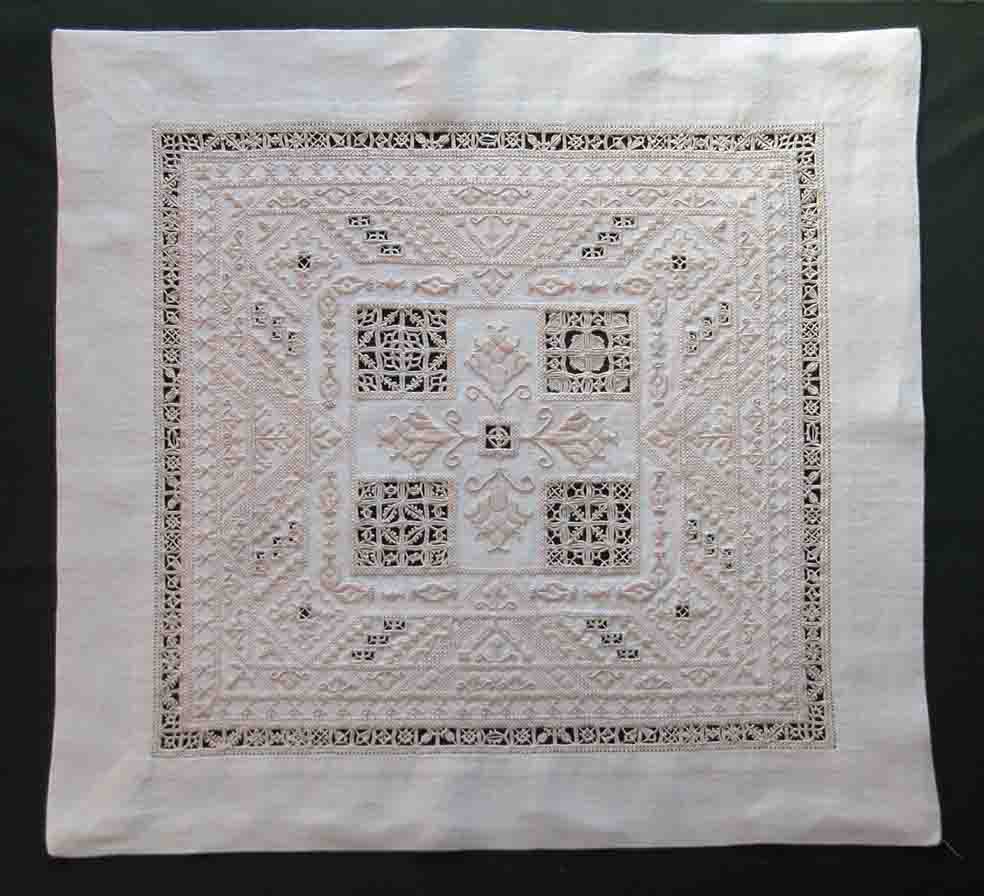
Dans mon article précédent je vous ai présenté le Sampler di Irma dans son intégralité.  Cette fois-ci, examinons de plus près la partie centrale de cette création de Giuliana Buonpadre.

In the preceding review I introduced to you the Sampler di Irma as a whole.  Let's take a closer look this time to the central part of Giuliana Buonpadre's creation.

In het vorig artikel heb ik u laten kennismaken met de Sampler di Irma in zijn geheel.  Deze keer bekijken we het centrale gedeelte van Giuliana Buonpadre's creatie van dichtbij.


Sampler di Irma - Le carré central
Le grand carré central du Sampler di Irma est tracé, comme toutes les autres sections de cet ouvrage d'ailleurs, au point carré.
Le centre est constitué d'un tout petit carré, tracé au point carré lui aussi, dans lequel j'ai brodé une roue au point de feston avec des petites fleurs au point de poste.  De chaque côté de ce petit carré se trouve un joli motif de style punto antico au passé plat et au point de poste, agrémenté d'une ligne au point frisé.
Les angles du grand carré central sont garnis d'un cadre comportant 16 fenêtres de reticello.  Ces 4 cadres ont été, eux aussi, tracés d'abord au point carré puis pourvus d'un cadre intérieur en brodant le point cordonnet sur quelques fils.  Ensuite, en coupant quelques fils en chaîne et en trame, et en consolidant les fils restants au point de reprise, chaque cadre obtint l'aspect d'une grille à 16 fenêtres.  Finalement, j'ai pourvu chaque fenêtre d'un motif de reticello.

Je vous propose maintenant de regarder deux de ces cadres en détail :

1. Le cadre aux clochettes


Ce cadre contient 4 clochettes (campanelle en italien) au centre et 1 clochette dans chaque angle.  Chaque clochette est agrémentée de 3 picots.
Les 8 autres fenêtres du cadre sont remplies d'un losange avec picots.  Rombi con pippiolini ça s'appelle en italien.

2. Le cadre aux épis


Je l'appelle cadre aux épis parce que chacune des 4 fenêtres centrales contient un épi (spiga).  Ces épis sont enjolivés de part et d'autre de 3 picots et placés entre deux arcs exécutés au point de feston.
Dans chaque angle du cadre se trouve un croisement avec losange et picots, ce que Giuliana Buonpadre appelle dans son livre incrocio con rombo e pippiolini.
Les 8 fenêtres restantes sont remplies d'une fiore a punto festone con stami (fleur au point de feston avec étamines).


Sampler di Irma - The central square
The large central square of the Sampler di Irma, just like all other sections of this embroidery, has been drawn in square stitch.
In the very centre there is a little square in which I embroidered a wheel in buttonhole stitch with tiny flowers in bullion stitch.  On each side of this little square there is a punto antico pattern, executed in satin stitch and bullion stitch and embellished with a line in curl stitch.
Each corner of the large central square contains a frame with 16 windows in reticello.  These 4 frames too have been drawn previously in square stitch.  After that an inside frame has been made by executing the whip stitch upon some threads.  By then cutting away some threads in warp and weft, and by consolidating the remaining threads in darning stitch, I transformed each frame into a grid of 16 windows.  Finally I embroidered a reticello pattern in each of the windows.

Let's have a closer look now at two of those frames :

1. The frame with the little bells


This frame contains four little bells (campanelle in Italian) in its centre and one little bell in each corner.  All bells are embellished with three picots.
In each of the eight remaining windows I embroidered a rhombus with picots, called rombo con pippiolini in Italian.

2. The frame with the ears of corn


Each of the 4 central windows of this frame contains an ear of corn (spiga in Italian) with 3 picots on both sides of it and placed between two little arches executed in buttonhole stitch.
In each corner of the frame a cross with rhombus and picots has been embroidered, called incrocio con rombo e pippiolini in Giuliana Buonpadre's book.
The eight remaining windows are filled up with a fiore a punto festone con stami (flower in buttonhole stitch with stamens).


Sampler di Irma - Het centrale vierkant
Het groot centraal vierkant van Sampler di Irma is, net als alle andere secties van dit borduurwerk, getekend in hokjessteek.
Precies in het midden ervan bevindt zich een klein vierkantje waarin een wieltje in festonsteek is geborduurd met bloemetjes in bouillonsteek.  Op elke zijde van dit klein vierkant is een punto anticomotief aangebracht in platsteek en bouillonsteek, verfraaid met een lijn in krulsteek.
Elke hoek van het grote centrale vierkant bevat een kader met 16 vensters in reticello.  Ook deze 4 kaders zijn eerst en vooral getekend in hokjessteek.  Daarna is een binnenkader aangebracht door over enkele draden de cordonsteek uit te voeren.  Door vervolgens sommige draden in schering en inslag weg te knippen en de resterende draden met stopsteek te verstevigen kreeg elk kader het uiterlijk van een raam met 16 venstertjes.  Ten slotte heb ik in elk van die venstertjes een reticellomotief geborduurd.

Ik stel voor in dit artikel twee van de kaders in detail te bekijken :

1. Het kader met de klokjes


Het eerste kader bevat 4 klokjes (campanelle in het Italiaans) in het centrum en een klokje in elke hoek.  Elk klokje is bovendien verfraaid met 3 picots.
In de overige 8 venstertjes is een ruit met picots geborduurd.  Rombo con pippiolini klinkt het in het Italiaans.

2. Het kader met de korenaren


Elk van de 4 centrale venstertjes van dit kader bevat een korenaar (spiga) met 3 picots aan weerskanten, geplaatst tussen twee boogjes uitgevoerd in festonsteek.
In elke hoek van het kader is een kruis met ruit en picots geborduurd.  Incrocio con rombo e pippiolini heet dat in het boek van Giuliana Buonpadre.
De acht resterende vensters zijn opgevuld met een fiore a punto festone con stami (bloem in festonsteek met meeldraden).


Dans le prochain article je vous présenterai les deux autres cadres du carré central en détail.
Mais avant de terminer, voici votre dose d'histoire.

The other two frames of the large central square will be treated of in my next post.
But before closing this one I give you another dose of history.

De twee overige kaders in het centrale vierkant van de Sampler di Irma bekijken we van dichtbij in het volgend artikel.
Maar vooraleer af te sluiten bied ik u nog een portie geschiedenis aan.


DU RETICELLO A LA DENTELLE A L'AIGUILLE : L'HISTOIRE (2/5)

Les petits carrés ajourés qui se formaient donc en tirant quelques fils en chaîne et en trame et en coupant d'autres en partie, furent remplis au départ uniquement de motifs géométriques simples et répétitifs.  Ceci, sans aucun doute, sous l'influence de son origine, qu'était la culture arabe et qui, inspirée par la religion islamique, manifestait de l'aversion pour les images naturalistes.
Dans l'étape suivante les brodeuses vénitiennes, recherchant sans cesse davantage de luxe et de raffinement, commencèrent à couper des morceaux de toile toujours plus grands.  Ensuite, dans les grandes fenêtres ainsi formées, quelques nouveaux fils furent tendus sur lesquels on brodait plus librement, sans l'obligation de suivre chaîne et trame qui, eux, ne permettaient qu'un remplissage de simples motifs géométriques.  Ce processus ouvrait non seulement la possibilité de remplir les fenêtres de motifs plus variés et complexes (fleurs, feuilles, animaux, figures) mais aussi, par de nouveaux points, de rendre l'ouvrage plus fin et en même temps plus riche.


Image 2

Le résultat à ce stade prend déjà tellement l'aspect d'une dentelle que le Reticella peut être considéré à juste titre comme une forme de dentelle à l'aiguille et ainsi comme le précurseur de la vraie dentelle (voir Image 2).
Avec le temps, et dans l'intention de rendre les jours toujours plus aérés et plus délicats, la tendance grandit à tirer et à couper autant de fils, que la toile elle-même devint aussi frêle qu'elle ne supportait plus de broderie.  Pour y remédier les brodeuses créèrent alors une grille de fils qu'elles fixèrent sur du parchemin.  Ensuite elles effectuèrent la broderie sur la nouvelle grille et finalement coupèrent le parchemin.  Cette technique, appelée à l'époque Punto in Aria (Points dans l'Air), peut être qualifiée de véritable dentelle à l'aiguille, car dès qu'on travaille séparément de la toile on ne parle plus de broderie, mais il s'agit de dentelle.

Image 3

Ainsi, à partir du 16ème siècle on commença à enrichir la broderie traditionnelle d'ourlets en Punto in Aria.  Ces bords, étant effectués séparément de la toile elle-même, furent attachés par la suite au lin déjà brodé.  Voilà pourquoi, dans les oouvrages qui subsistent de cette époque, nous retrouvons souvent le Reticello et le Punto in Aria en combinaison l'un avec l'autre (voir Images 2 et 3).


FROM RETICELLO TO NEEDLELACE : THE HISTORY (2/5)

The openwork squares, formed by removing some threads in both directions and by partly cutting away some other ones, initially were filled up with simple and repetitive geometric patterns.  This, undoubtedly under the influence of the Arab culture which, inspired by Islamic religion, has always been shy of presenting naturalistic images.
But in a further stage Venetian embroiderers, continually looking for more luxury and elegance, started to cut away ever larger pieces from the fabric.  In the openwork areas that were formed that way, some new threads were then placed so that embroidery no longer was limited to follow warp and weft.  This new technique not only made it possible to fill up the bigger openwork areas with more complex and varied motifs (flowers, leaves, animals, figures), but also by way of new stitches to give a much richer appearance to the embroidery.

Image 2
The result at this stage is beginning to resemble so much to lace that Reticello rightly may be considered as a form of needle lace and even the precursor of real lace (see Image 2).
Finally, and with the intention of making the openwork even lighter and more refined, tendency grew to draw out and to cut so many threads that the fabric itself became too flimsy to support any embroidery.  The solution was found by creating a grid of threads that was fixed on parchment.  The embroidery then was executed on this new grid after which the parchment was cut away again.  This technique, called Punto in Aria (Stitch in the Air), may be considered as the very first form of real lace, because once the work is executed apart from the fabric we no longer talk about embroidery, but we start talking about lace.

Image 3

So, from the 16th century on we can observe traditional embroidery enriched with borders in Punto in Aria.  These were no longer done on the fabric itself but executed separately and attached to the already embroidered linen.  That's why in the pièces conserved from that time we often find Reticello and Punto in Aria combined with one another (see Images 2 and 3).


VAN RETICELLO TOT KANT : DE GESCHIEDENIS (2/5)

De open vierkantjes, die dus ontstonden door enkele draden in beide richtingen uit te trekken en andere gedeeltelijk weg te knippen, werden aanvankelijk uitsluitend opgevuld met eenvoudige en repetitieve geometrische motieven.  Dit ongetwijfeld nog onder invloed van de Arabische cultuur die, geïnspireerd door de mohammedaanse godsdienst, zich afkerig toonde van naturalistische afbeeldingen.
In een volgend stadium begonnen de Venetiaanse borduursters, op zoek naar meer luxe en raffinement, steeds grotere stukken uit de stof weg te knippen en de aldus ontstane leegten te voorzien van enkele zelf gespannen draden, waarop dan verder kon worden geborduurd zonder de verplichting schering en inslag te volgen.  Dit procédé opende niet alleen de mogelijkheid het lichtere ajourwerk met meer gevarieerde en complexere motieven op te vullen (bloemen, blaadjes, dieren, figuren), maar ook via nieuwe steken het borduurwerk een fijner en tegelijkertijd rijker aspect te verlenen.

Afbeelding 2
Het resultaat begon in dit stadium al zodanig op kant te lijken dat Reticello terecht als een vorm van naaldkant en als de voorloper van het echte kantwerk mag beschouwd worden (zie Afbeelding 2).
Op de duur, en met de bedoeling het ajourwerk nog luchtiger en fijner te maken, groeide de tendens om zoveel draden uit te trekken en weg te knippen, dat er eigenlijk niet meer op de stof zelf kon worden geborduurd.  Daarom ontwierpen de borduursters een rooster van draden en zetten dit vast op perkament.  Op dit nieuwe rooster werd het borduurwerk dan uitgevoerd en het perkament werd vervolgens weer weggeknipt.  Deze techniek, aangeduid met de naam Punto in Aria (Steken in de Lucht), mag terecht worden beschouwd als de eerste vorm van het echte kantwerk, want vanaf het ogenblik dat er onafhankelijk van de stof wordt gewerkt hebben we het niet meer over borduren, maar spreken we over kantwerk.


Afbeelding 3

Vanaf de 16de eeuw begon men het traditioneel borduurwerk aldus te verrijken met boorden in Punto in Aria.  Deze waren onafhandelijk van de stof zelf uitgevoerd en achteraf vastgemaakt aan het reeds geborduurde linnen.  Vandaar dat we Reticello en Punto in Aria in de nagelaten stukken van die tijd vaak in combinatie aantreffen (zie Afbeeldingen 2 en 3).

_________________________________________

Astuce : Par un simple clic sur une des photos dans un article de mon blog vous activerez le mode lightbox, dans lequel vous pouvez faire défiler toutes les images l'une après l'autre sur fond noir.  Cliquez sur la croix blanche en haut à droite pour retourner au blog.

Tip : With a simple click on one of the photos in a review of my blog you will activate the lightbox mode, where you can view all pictures one by one on black background.  Click on the white cross at the top right to return to the blog.

Tip : Met een eenvoudige muisklik op een van de foto's in een artikel van mijn blog activeert u de lightbox-modus, waarin u alle foto's een na een kunt laten defileren op zwarte achtergrond.  Klik op het wit kruisje bovenaan rechts om terug te keren naar het blog.


samedi 19 octobre 2013

RETICELLO - PUNTO ANTICO - Giuliana Buonpadre (1/5)


L'ouvrage que j'aimerais vous présenter cette fois-ci s'appelle Sampler di Irma.  Il a été conçu par la créatrice italienne Giuliana Buonpadre.  Modèle, description et illustrations sont publiés dans son livre Sulle tracce del filo. Lenzuola, Samplers a Punto Antico (Giuliana Buonpadre, Verona 2011).  Les textes sont rédigés en italien, français et anglais.
Le Sampler di Irma est tellement riche et rempli que j'ai étalé ma présentation sur 5 articles.  Ce qui me permet également de publier le résultat de mes recherches sur l'origine et le développement du reticello et de la dentelle à l'aiguille ; un récit historique que j'aimerais bien partager avec vous.


The embroidery I wish to present you this time is called Sampler di Irma.  It has been created by the Italian designer Giuliana Buonpadre.  Pattern, description and illustrations are to be found in her book Sulle tracce del filo. Lenzuola, Samplers a Punto Antico (Giuliana Buonpadre, Verona 2011).  Texts are in Italian, French and English.
Sampler di Irma is so abundantly filled that I have spread my presentation over 5 reviews.  This also allows me to post the result of my research on the origins and development of reticello and needle lace ; a historical story that I'd like to share with you.


Het borduurwerk dat ik u in dit artikel wens voor te stellen heet Sampler di Irma en werd gecreëerd door de Italiaanse ontwerpster Giuliana Buonpadre.  Patroon, beschrijving en illustraties zijn gepubliceerd in haar boek Sulle tracce del filo. Lenzuola, Samplers a Punto Antico (Giuliana Buonpadre, Verona 2011).  De teksten zijn in het Italiaans, Frans en Engels.
Sampler di Irma is zo weelderig en gevuld dat ik mijn beschrijving met de onontbeerlijke illustraties over 5 artikels heb gespreid.  Dit laat me ook toe het resultaat van mijn opzoekingen over het ontstaan en de ontwikkeling van reticello en naaldkant te publiceren ; een historisch verhaal dat ik graag met u wil delen.


Mais avant tout, un petit mot sur la créatrice de ce chef-d'oeuvre.
Giuliana Buonpadre a passé son enfance dans les Abruzzes, une région dans le sud de l'Italie centrale.  C'est sa grand-mère qui, en initiant Giuliana à la broderie, a allumé en elle l'amour pour le fil et le tissu.  Le divertissement pour enfants tournera en passion ardente.
L'école de broderie Scuola Filofilo à Vérone est une fondation de Giuliana Buonpadre.  De plus, elle a publié déjà 8 livres de broderie.  Et, toujours accompagnée de Vito, son mari inséparable et complaisant, Giuliana dirige des stages de broderie dans plusieurs pays européens.  Vous pouvez rencontrer ce couple charmant aussi aux principaux salons et foires : Forum di Italia Invita à Parma, Abilmente à Vicenza, L'Aiguille en Fête à Paris, et d'autres encore.
Je me félicite de pouvoir rencontrer Giuliana Buonpadre régulièrement.  On éprouve un plaisir exceptionnel à recevoir son enseignement, profitant ainsi de son expérience impressionnante et de son riche bagage culturel qu'elle partage généreusement en toutes simplicité et modestie.
Pour savoir plus sur Giuliana Buonpadre, ses stages et ses livres, cliquez sur Filofilo.


But first of all a few words about the designer of this embroidery model.
Giuliana Buonpadre spent her childhood in Abruzzo, a region in southern central Italy.  It was her grandmother who initiated Giuliana into embroidery and imparted to her the love for threads and fabric.  Children's entertainment would turn into fiery passion.
The embroidery school Scuola Filofilo in Verona (Italy) is a foundation of Giuliana Buonpadre.  Furthermore, she already published 8 embroidery books.  And, inseparably accompanied by Vito, her helpful husband, she also leads embroidery classes in several European countries.  You may also meet this cordial couple on the most important needlework fairs, such as Forum di Italia Invita in Parma, Abilmente in Vicenza, L'Aiguille en Fête in Paris, and many others.
I count myself lucky to be able to meet Giuliana Buonpadre regularly.  It is an exceptional pleasure to receive instruction from her and to take advantage of her rich experience and broad cultural baggage that she shares generously with simplicity and modesty.
If you like to read more about Giuliana Buonpadre, her books and her embroidery classes, click on Filofilo.


Maar eerst een woord over de ontwerpster van dit borduurwerk.
Giuliana Buonpadre heeft haar kinderjaren doorgebracht in de Abruzzen, een regio in zuidelijk centraal Italië.  Het was haar grootmoeder die Giuliana inwijdde in het borduren en haar de liefde voor weefsel en draad bijbracht.  Wat was begonnen als kindervermaak zou uitgroeien tot vurige passie.
De borduurschool Scuola Filofilo in Verona is een stichting van Giuliana Buonpadre en ze heeft intussen al 8 borduurboeken op haar naam staan.  Samen met Vito, haar hulpvaardige en onafscheidelijke echtgenoot, leidt Giuliana workshops in verscheidene landen van Europa.  U kunt dit sympathieke koppel ook ontmoeten op de belangrijkste beurzen en salons voor handwerk : Forum di Italia Invita te Parma, Abilmente te Vicenza, L'Aiguille en Fête te Parijs, e.a.
Ik prijs me gelukkig Giuliana Buonpadre regelmatig te kunnen ontmoeten.  Het is een uitzonderlijk genoegen onderricht van haar te krijgen en aldus te kunnen genieten van haar rijke ervaring en brede culturele bagage die ze in alle eenvoud en bescheidenheid genereus met u deelt.
Wilt u meer weten over Giuliana Buonpadre, haar workshops en boeken, klik dan op Filofilo.


Sampler di Irma - L'ensemble
La structure du Sampler di Irma, qui divise l'ensemble en plusieurs sections, est dessinée au point carré.  Le tout début de cet ouvrage consiste donc à tracer chaque composant au point carré.  Alors seulement on peut entamer le remplissage.
Le carré central se compose de 4 cadres, comprenant chacun 16 fenêtres en reticello.  Entre les 4 cadres se trouvent de gracieux motifs en punto antico, effectués au passé plat, point de poste et point frisé.
Les larges bandes autour du carré central, identiques deux par deux, sont remplies au style punto antico : ici encore passé plat, point de poste et point frisé.
Enfin, l'ensemble est entouré d'un cadre étroit constitué de 120 petites fenêtres en reticello (4 fois 30).
Giuliana Buonpadre a présenté son Sampler di Irma pour la première fois au Forum di Italia Invita 2003.  Il était brodé en couleur, par une certaine Irma, d'où son nom.
Pour ma version à moi j'ai préféré un ouvrage ton sur ton afin de le faire mieux correspondre au reticello authentique du 16ème siècle.  C'est dans le même souci que j'ai choisi du lin et des fils fins.
Mon Sampler di Irma mesure 50 cm sur 50 cm et a été brodé sur du Lin Sotema Avorio 15 fils/cm de 60 cm sur 60 cm, avec des aiguilles à bout rond n° 28 et des aiguilles à bout pointu n° 9.  En fils il m'a fallu 20 g d'Anchor Fiorentino n° 12 couleur 387 et 1,5 bobine de DMC Dentelle n° 80 écru.
Certes, ce modèle s'exécute parfaitement sur du lin de 12 fils par cm avec du Perlé nos. 8 et 12, ce qui devrait donner à l'ensemble un aspect totalement différent d'ailleurs.  D'autre part, pour obtenir un effet plut mat vous pourriez utiliser du coton à broder nos. 20 et 30.  Mais pour donner une dimension complètement différente au Sampler di Irma, il faut le broder en couleur, tel que présenté dans le livre de Giuliana Buonpadre.
Le Sampler di Irma, de par son remplissage complet, correspond au style des anciens reticello et punto antico.  Sa richesse de motifs, pouvant représenter une source d'inspiration abondante pour vos propres créations, rend ce modèle une base sans égal pour toute brodeuse qui veut pratiquer le reticello et le punto antico.


Sampler di Irma - A general survey
The structure of Sampler di Irma, which divides the work into several sections, has been drawn in square stitch.  So, the very beginning of this embroidery consists in the outlining of each section in square stitch.  Only then you can start filling the different areas.
The central square includes 4 frames, each of them containing 16 windows embroidered in reticello.  Between these 4 frames there are beautiful punto antico patterns in satin stitch, bullion stitch and curl stitch.
The wide bands around the central square, identical two by two, are completely filled up in punto antico fashion : here again satin stitch, bullion stitch and curl stitch.
Finally, the whole is surrounded by a narrow framework containing 120 little windows in reticello (4 x 30).
Giuliana Buonpadre presented her Sampler di Irma for the very first time on the Forum di Italia Invita 2003.  It had been embroidered in colour, by a certain Irma, hence its name.
I myself have preferred a monochrome version in order to bring it more in accordance with the authentic reticello of the 16th century.  For the same reason I chose fine linen and thread.
My Sampler di Irma measures 50 cm by 50 cm and has been embroidered on a Linen Sotema Avorio 38 count of 60 cm by 60 cm, with tapestry needles No 28 and sharps No 9.  Required thread : 20 g of Anchor Fiorentino No 12 colour 387 and 1,5 ball of DMC Dentelle No 80 ecru.
Certainly, this model is perfectly feasible on linen 30 count with Perlé No 8 and No 12, which should in fact lend a completely different aspect to the work.  To obtain a matter effect you might use coton à broder No 20 and No 30.  And to give Sampler di Irma a totally new dimension it could be embroidered, of course, in colour, as presented in Giuliana Buonpadre's book.
The overall embroidery used in Sampler di Irma reminds of early reticello and punto antico.  Its wealth of patterns, which could be an abundant source of inspiration for your own creations, makes it a perfect basis for those who want to realize reticello and punto antico embroidery.


Sampler di Irma - Algemeenheden
Het stramien van Sampler di Irma, dat het geheel in secties verdeelt, is getekend met hokjessteken.  De start van dit borduurwerk bestaat dus uit de omlijning van elk onderdeel in hokjessteek.  Pas daarna kan met de opvulling worden begonnen.
Het centrale vierkant bestaat uit 4 kaders die elk 16 vensters in reticello bevatten.  Tussen deze 4 kaders in bevinden zich fraaie punto antico-motieven in platsteek, bouillonsteek en krulsteek.
De brede banden rond het centrale gedeelte zijn twee aan twee identiek en helemaal opgevuld in punto anticostijl : ook hier weer platsteek, bouillonsteek en krulsteek.
Het geheel is ten slotte omgeven met een smal kader dat in totaal 120 venstertjes in reticello bevat (4 x 30).
Giuliana Buonpadre heeft haar Sampler di Irma voor de eerste keer voorgesteld op het Forum di Italia Invita 2003.  Hij was geborduurd in kleur, door een zekere Irma, waarvan zijn naam.
Ikzelf heb de voorkeur gegeven aan een eenkleurige uitvoering, om deze meer in overeenstemming te brengen met de authentieke reticello uit de 16de eeuw.  Om dezelfde reden heb ik gekozen voor fijn linnen en garen.
Mijn uitvoering van Sampler di Irma meet 50 cm op 50 cm en is geborduurd op een Lin Sotema Avorio 15 draads van 60 cm op 60 cm, met naalden ronde punt nr. 28 en naalden scherpe punt nr. 9.  Als garen was daarvoor nodig : 20 g Anchor Fiorentino nr. 12 kleur 387 en anderhalf bolletje DMC Dentelle nr. 80 ecru.
Maar dit model is perfect uitvoerbaar op linnen van 12 draden per cm en met Perlé nrs. 8 en 12, wat aan het geheel trouwens een compleet ander aspect zou verlenen.  Om een matter effect te verkrijgen zou u coton à broder nrs. 20 en 30 kunnen gebruiken.  En om Sampler di Irma een geheel andere dimensie te geven kan hij uiteraard ook in kleur worden geborduurd, zoals Giuliana Buonpadre hem in haar boek heeft voorgesteld.
Sampler di Irma beantwoordt, door zijn volledige opvulling, aan de vroege reticello- en punto anticostijl.  Door zijn rijkheid aan motieven, die een ideale inspiratiebron kunnen betekenen voor uw eigen ontwerpen, is dit handwerk de gedroomde basis voor al wie reticello- en punto anticoborduurwerk wil uitvoeren.


J'aimerais bien examiner avec vous cet ouvrage somptueux de plus près dans les quatre articles suivants.  Mais avant de terminer celui-ci, et comme mentionné dans l'introduction, une portion d'histoire.

DU RETICELLO A LA DENTELLE A L'AIGUILLE : L'HISTOIRE (1/5)
Que le berceau du Reticella (appelé également Reticello) se trouve de toute probabilité à Venise ne devrait pas surprendre.
Des relations commerciales séculaires avec l'Orient avaient rendu Venise la porte d'entrée vers l'Europe pour tous les produits commerciaux et toutes les influences culturelles en provenance de l'Inde, de Chine, de Grèce et de Constantinople.  Non seulement des métaux précieux et des épices furent importés, mais aussi la soie et les tissus brodés trouvèrent leur voie vers les marchés italiens et les autres foires européennes.  Grâce à sa puissante flotte, qui contrôlait l'ensemble de la Méditerranée orientale, cet état italien indépendant se développa dès le 12ème siècle en la plus forte puissance économique de l'Europe.  Au cours des 12ème, 13ème et 14ème siècles Venise atteignit son apogée commercial et fut le précurseur en Europe de la culture, du luxe, du raffinement et de l'élégance.
A la suite de cette prospérité et cette abondance un mouvement d'état d'esprit commença à se manifester dès la fin du 14ème siècle dans le nord de l'Italie.  Intellectuels et artistes, persuadés de se trouver sur le seuil d'une Nouvelle Epoque, rompirent intentionnellement avec la mentalité dépressive, dominée par la religion, fataliste et culpabilisante du bas Moyen Âge.  Les partisans de cette idée (appelés les Humanistes), inspirés par les exemples de l'Antiquité, défendirent une image optimiste de l'humanité et préconisèrent la liberté d'opinion.  La beauté, le luxe, la richesse et profiter de la vie n'étaient plus des péchés.  Carpe Diem (Cueillez le Jour) devint la devise.
Cette nouvelle attitude et le bien-être social résultant du commerce florissant se reflétaient dans tous les domaines de la vie et de la société : l'architecture, la peinture, la musique, sciences et découvertes, l'enseignement, la théologie, la mode, le style et la morale.  Né dans les cités italiennes les plus importantes comme Florence, Gênes, Rome et Venise, ce mouvement culturel se répandit durant les deux siècles suivants dans toute l'Europe occidentale.  Cette période et son idéologie caractéristique entreraient dans l'histoire sous le nom de Renaissance.  Or,ce fut précisément cette ambiance de Renaissance précoce de la Venise du 15ème siècle qui fut fonction de couveuse pour la naissance du Reticello.


Image 1

Les jours en tant que garniture de tissus et de vêtements, selon toute vraisemblance importés de l'Orient, existaient déjà depuis assez longtemps, en se réduisant toutefois à tirer les fils de la toile dans un sens unique (punto tirato) et à travailler les fils restants.
Dans un penchant vers la richesse et le raffinement, tendance propre à l'Italie renaissante du 15ème siècle, on commença, non seulement à tirer des fils dans les deux sens (chaîne et trame), mais aussi à couper une partie des fils restants (broderie découpée, point coupé, punto tagliato) de telle façon qu'un squelette de nombreux petits carrés se forme, rendant à la toile l'aspect d'un filet.  Le Reticella était né.  D'ailleurs, le mot italien reticella, traduit littéralement, signifie petit filet. 
Image 1 montre un ouvrage en reticello du 16ème siècle demeuré inachevé, certes, mais qui, exactement pour cette raison donne une excellente idée des différents phases dans cette technique de broderie.
Le terme Reticellis apparaît pour la toute première fois dans un contrat de mariage de 1403.  Et le nom Radexelo (Reticello) figure dans un inventaire d'héritage de la famille milanaise Sforza daté de 1493.  Cependant, il faut attendre jusqu'en 1591 pour retrouver le terme Reticello dans un livre de patrons de broderie (Vecellio)
A suivre...


In the next 4 reviews I'd like to show you all details of this sumptuous embroidery.  However, before ending this review, and as mentioned in the introduction, here is a portion of history.

FROM RETICELLO TO NEEDLE LACE : THE HISTORY (1/5)
That the origins of Reticella (also called Reticello) lie in Venice (Italy) may not surprise.
Centuries of intense commercial contacts with the East had turned Venice into the main entrance gate of Europe for all merchandise and cultural influences from India, China, Greece and Constantinople.  Not only precious metals and spices were imported, but also silk and embroidered fabrics from the Orient found their way via Venice to the Italian and other European markets.  Thanks to its strong fleet, which dominated the entire eastern Mediterranean, this independant Italian city-state from the 12th century on developed into the strongest economic power in Europe.  During the 12th, 13th and 14th century Venice came to its commercial height and was the precursor in Europe of culture, luxury and elegance.
From the end of the 14th century on, and as a result of this wealth and luxury, a transformation in vision on life began to manifest itself in northern Italy.  Intellectuals and artists were convinced that a New Era had arrived.  So they consciously wanted to break up with the depressing, guilt-ridden, fatalistic and religion-controlled mentality of the Late Middel Ages.  The followers of this idea (the Humanists) argued for an optimistic view on mankind and freedom of thought, inspired by the examples of Classical Antiquity.  Wealth, beauty and enjoying life were no longer sinful.  Carpe Diem (Seize the Day) became the motto.
This new attitude and the social well-being resulting from the flourishing commerce were soon reflected in all aspects of life and society : architecture, painting, music, science and discoveries, education, theology, fashion, style and decencies.  Originated in the most important Italian city-states as Firenze, Genoa, Rome and Venice, this cultural movement in the following two centuries spread all over Western Europe.  This period and its characteristic new ideology go down in history under the name Renaissance.  So, it was exactly this early renaissance atmosphere in fifteenth-century Venice that served as incubator for the birth of Reticello embroidery.

Image 1

Openwork as embellishment on fabric and clothing, in all likelihood imported from the East, already existed for quite some time, but was limited to some threads drawn out from the fabric in a single direction (punto tirato) and embroidering the remaining ones.  In a longing for more luxury and refinement, a characteristic property of fifteenth-century renaissance Italy, embroiderers also began, besides removing threads in the two directions (warp and weft), to cut away a part of the remaining threads (broderie découpée, point coupé, punto tagliato) in such a way that a skeleton of numerous small squares was formed which gave to the fabric the appearance of a net.  Reticella was born.  Besides, the Italian word reticella, translated literally, means little net. 
Image 1 shows a sixteenth-century reticella remained unfinished indeed, but which exactly for this reason gives an excellent idea of the different stages in this embroidery technique.
The name Reticellis appears for the very first time in a marriage settlement of 1403.  And in 1493 the name Radexelo (Reticello) occurs in a legacy inventory of the Milanese Sforza family.  But we have to wait until 1591 to find the term Reticello in a book with embroidery patterns (Vecellio).
To be continued...


In de volgende 4 artikels wil ik graag met u dit somptueus borduurwerk in al zijn details bekijken.  Maar, zoals vermeld in de inleiding, eerst nog een dosis geschiedenis.

VAN RETICELLO TOT KANT : DE GESCHIEDENIS (1/5)
Dat de bakermat van Reticella (ook Reticello genoemd) naar alle waarschijnlijkheid in Venetië staat, mag ons niet verwonderen.
Eeuwenlange intense commerciële contacten met het Oosten hadden Vénétie gevormd tot de belangrijkste ingangspoort naar Europa voor alle handelsproducten en culturele invloeden uit Indië, China, Griekenland en Constantinopel.  Niet alleen werden edele metalen en specerijen ingevoerd, maar ook zijde en geborduurde stoffen uit de Oriënt vonden via Vénétie hun weg naar de Italiaanse en andere Europese markten.  Dankzij zijn sterke vloot, die de hele oostelijke Middellandse Zee beheerste, ontwikkelde deze onafhankelijke Italiaanse staat zich vanaf de 12de eeuw tot de sterkste economische macht van Europa.  Gedurende de 12de, 13de en 14de eeuw beleefde Venetië zijn commercieel hoogtepunt en vertegenwoordigde in Europa de voorloper van cultuur, weelde en verfijndheid.
Als gevolg van deze rijkdom en luxe begon zich in het noorden van Italië vanaf het einde van de 14de eeuw een verandering in de levenshouding te manifesteren.  Intellectuelen en kunstenaars waren ervan overtuigd dat een Nieuwe Tijd was aangebroken en wensten bewust te breken met de depressieve, door godsdienst beheerste, fatalistische en schuldbeladen mentaliteit van de Late Middeleeuwen.  De aanhangers van deze gedachte (de Humanisten) pleitten voor een optimistisch mensbeeld en vrijheid van gedachte, geïnspireerd op de voorbeelden van de Klassieke Oudheid.  Rijkdom, schoonheid en genieten van het leven waren niet langer zondig.  Carpe Diem (Pluk de Dag) werd het motto.
Deze nieuwe houding en de maatschappelijke welstand tengevolge van de goed florerende handel kwamen al spoedig tot uiting in alle aspecten van het leven en de samenleving : de architectuur, de schilderkunst, de muziek, wetenschap en ontdekkingen, opvoeding, theologie, mode, stijl en fatsoen.  Ontstaan in de belangrijkste Italiaanse stadstaten (Firenze, Genua, Rome, Vénétie) verspreidde deze culturele beweging zich in de volgende twee eeuwen over heel West-Europa.  Deze periode en haar kenmerkende nieuwe ideologie zouden de geschiedenis ingaan onder de naam Renaissance.  Welnu, het was precies deze vroege renaissance-atmosfeer van het 15de-eeuwse Venetie die de couveuse vormde voor de geboorte van de Reticello.


Afbeelding 1

Ajourwerk als versieringstechniek van stoffen en kledij, naar alle waarschijnlijkheid geïmporteerd uit het Oosten, bestond al geruime tijd, maar beperkte zich tot het uittrekken van draden in één enkele richting (punto tirato) en het bewerken van de overgebleven draden.
In een drang naar meer luxe en verfijning, eigen aan het 15de-eeuwse renaissancistische Italië, begon men, benevens het uittrekken van draden in beide richtingen (schering en inslag), ook nog een deel van de overgebleven draden zodanig weg te knippen (broderie découpée, point coupé, punto tagliato) dat een skelet van talrijke kleine vierkantjes ontstond die de stof het aspect van een net verleende.  De Reticella was geboren.  Trouwens, het Italiaanse woord reticella betekent, letterlijk vertaald, netje.
Afbeelding 1 laat een 16de-eeuwse reticello zien die weliswaar onvoltooid is gebleven, maar precies om die reden een uitstekend beeld geeft van de verschillende stadia in deze borduurtechniek.
De benaming Reticellis verschijnt voor de allereerste keer al in een huwelijkscontract van 1403.  En in 1493 vinden we de naam Radexelo (Reticello) terug in een erfenisinventaris van de Milanese familie Sforza.  Maar het is wachten tot 1591 om de term Reticello in een boek met borduurpatronen aan te treffen (Vecellio).
Wordt vervolgd...


vendredi 11 octobre 2013

SEPPE'S FRIEND


Ce doudou fait maison me semblait un joli petit présent pour la naissance de Seppe, le troisième petit-enfant de nos amis en Flandre.  Un cadeau bien mérité : venir au monde n'est pas une mince affaire !

This homemade cuddly toy seemed a nice little present for the birth of Seppe, the third grandchild of friends in Flanders.  Richly deserved : coming into the world is no small matter !

Deze zelfgebreide troetelpoes leek me een leuk cadeautje voor de geboorde van Seppe, het derde kleinkind van onze vrienden in Vlaanderen.  Welverdiend ook : op de wereld komen is geen kleinigheid !


Le modèle de ce doudou a été publié sous le nom The Window Cat par Sara Elizabeth Kellner sur Ravelry, the place to be pour toutes les tricoteuses.  Le patron est gratuit et à télécharger directement sur http://www.ravelry.com/patterns/library/the-window-cat
J'ai tricoté Seppe's Friend avec des aiguilles n° 3.5 (US 4).

The model of this cuddly toy has been created by Sara Elizabeth Kellner and is published as The Window Cat on Ravelry, the place to be for all knitters.  The pattern is for free and can be downloaded directly from http://www.ravelry.com/patterns/library/the-window-cat
Seppe's Friend has been knitted with needles 3.5 (US 4).

Het model van deze troetelpoes is bekend onder de naam The Window Cat en is gepubliceerd door Sara Elizabeth Kellner op Ravelry, the place to be voor alle breisters.
Het patroon is vrij en rechtstreeks te downloaden op http://www.ravelry.com/patterns/library/the-window-cat
Seppe's Friend is gebreid met naalden 3.5 (US 4).


Seppe a vu le jour le 9 juillet 2013 et à juger d'après les photos il a déjà pris son doudou en tendre amitié.
Bonne chance à toi, Seppe !

Seppe saw the light of day on 9 July 2013 and to judge from the pictures he and his cuddly became close friends already.
A happy life to you, Seppe !

Seppe zag voor het eerst het daglicht op 9 juli 2013 en naar de foto's te oordelen heeft hij met de troetelpoes intussen al innige vriendschap gesloten.
Het ga je goed, Seppe !


Un gros merci à Tine et Alexander, la maman et le papa, pour les photos de leur adorable petit garçon.

Thanks to Tine and Alexander, the mum and dad, for the lovely pictures of their gorgeous little boy.

Met dank aan Tine en Alexander, de mama en de papa, voor de foto's van hun schattige zoon.

Related Posts Plugin for WordPress, Blogger...