mercredi 11 novembre 2015

LES CHÂLES de DEE O'KEEFE - DEE O'KEEFE's SHAWLS

Afin d'apporter un peu de variation dans le cycle de mon sampler en broderie Schwalm, je vous présente cette fois-ci deux châles que j'ai terminés cet été.

To bring some variation in my Schwalm sampler series I'd like to present you this time two shawls that I finished last summer.

Om even wat afwisseling te brengen in mijn Schwalm sampler serie stel ik jullie deze keer een tweetal sjaals voor die ik deze zomer heb afgebreid.


Ashton
Glenallen

Ces châles ont en commun que les deux modèles ont été conçus par la même créatrice : Dee O'Keefe.  Habitant à Alexandria aux Etats-Unis, cette dame s'y connaît dans tous les domaines : elle a été
Dee O'Keefe
successivement guitariste professionnelle, couturière, opticienne, trader, créatrice d'armoires et gérante d'un commerce d'ameublement.  Mais depuis 2011 elle fait un plein temps comme créatrice de modèles de tricot en dentelles et organisatrice d'ateliers de tricot et de crochet.  Voilà un esprit universel !
Les modèles des châles de Dee O'Keefe, tous publiés sur le site internet Ravelry, sont d'une clarté exceptionnelle : tout y est expliqué de fil en aiguille  -en anglais bien entendu-  et éclairci par des photos et des diagrammes.  Aux tricoteuses qui veulent se risquer pour la première fois dans le tricot en dentelle, je recommande les modèles de Dee O'Keefe

These.shawls have in common that both models have been created by the same designer : Dee O'Keefe.  Living in Alexandria (United States), this lady is well up in many areas of competence : she successively was a professional guitarist, seamstress, optician, stock trader, cabinetry designer and furniture store manager.  But since 2011 she is full time designing lace and teaching knitting and crocheting.  What a wide range of talents !
Dee O'Keefe's patterns, all published on the Ravelry website, are cristal-clear : everything is well explained and clearly illustrated with pictures and diagrams.  To those who want to become acquainted with lace knitting I can surely recommend the models designed by Dee O'Keefe.

Deze sjaals hebben met elkaar gemeen dat beide modellen door dezelfde ontwerpster zijn bedacht : Dee O'Keefe.  Deze dame, woonachtig in Alexandria (USA) is van vele markten thuis : ze was achtereenvolgens beroepsgitariste, naaister, opticien, beursmakelaar, ontwerpster van kasten en beheerder van een meubelzaak.  Maar sinds 2011 houdt ze zich voltijds bezig met het ontwerpen van kantbreiwerk en het geven van cursussen brei- en haakwerk.  Van een veelzijdig talent gesproken !
De breipatronen die Dee O'Keefe op de Ravelry website publiceert zijn van een verbluffende klaarheid : alles is haarfijn uitgelegd en helder aangevuld met foto's en schetsen.
Voor de breisters die met kantbreiwerk kennis willen maken kan ik de modellen van Dee O'Keefe warm aanbevelen.


ASHTON


La laine pour mon Ashton étant composée de 100% de fibre acrylique, j'ai eu du mal à bloquer ce châle.  Voilà la raison pour laquelle il a le bord roulé, ce qui ne me déplaît nullement d'ailleurs.

Having used a yarn composed of 100% acrylic fibre I had some trouble to block my Ashton shawl.  That's why it has a curly edge, which doesn't bother me in the least.

Vermits de gebruikte breiwol voor 100% uit acrylvezel bestond heb ik wat moeite gehad om deze sjaal behoorlijk te blokken.  Dat is ook de reden waarom de boord een beetje opkrult, wat me echter geenszins tegenstaat.


Le Ashton est le modèle par excellence pour les tricoteuses qui veulent découvrir les châles de Dee O'Keefe.  Il est le plus facile à tricoter.  Ca ne peut pas rater.  Et d'ailleurs, le diagramme est disponible à titre gracieux sur le site internet de Ravelry.

The Ashton is the outstanding model for knitters who want to become acquainted with the shawls of Dee O'Keefe.  Easy to knit.  Success guaranteed.  And besides, it's a free on the Ravelry website.

De Ashton is het model bij uitstek voor breisters die met de sjaals van Dee O'Keefe wensen kennis te maken.  Het is makkelijk breien.  Er kan niets fout gaan.  En bovendien is het patroon gratis te downloaden op de Ravelry website.


J'ai tricoté mon châle Ashton avec 757 mètres (113 g) de Katia Babette White.  En utilisant des aiguilles fines de 2,75 mm (US 2), j'ai obtenu le résultat recherché : un châle de structure dense, doux et chaud.  En plus, il supporte la machine à laver.
Afin d'obtenir un châle, plutôt qu'une "châlette", j'ai tricoté 12 répétitions du diagramme n° 2.
Dimensions : 160 x 70 cm

I knitted my Ashton shawl with 757 metres (1,157 yards/113 g) of Katia Babette White.  Using 2.75 mm (US 2) fine needles I got the result I wanted : a shawl of dense structure, soft and warm.  And besides, it goes in the washing machine.
In order to end up with a shawl rather than a shawlette, I did 12 repeats of chart No 2.
Dimensions : 160 x 70 cm.

Mijn Ashton is gebreid met 767 meter (113 g) Katia Babette White.  Door fijne breipennen van 2,75 mm (US 2) te gebruiken verkreeg ik precies het gezochte resultaat : een sjaal met een dichte structuur, warm en zacht.  En bovendien gaat hij in de wasmachine.
Een shawlette leek me wat aan de kleine kant, dus heb ik chart 2 in totaal 12 keer gebreid.
Afmetingen : 160 s 70 cm.


GLENALLEN


Ce sont les motifs d'Art Deco que la créatrice a découverts dans un dictionnaire de mailles, qui l'ont incitée à les appliquer dans un de ses modèles de châle en dentelle.  Une belle réussite d'ailleurs !
S'il était plus difficile à faire que le Ashton, le tricot du Glenallen était un vrai régal et j'y trouve un grand plaisir à le porter.

It were the Art Deco motifs the designer discovered in a stitch dictionary that incited her to use them in one of her lace shawl projects.  A great success indeed !
If this one was more difficult to make than the Ashton, the knitting of the Glenallen was a real pleasur and I find it a delight to wear it.

Het is de ontdekking van de Art Deco-motieven in een lexicon over breisteken die de ontwerpster ertoe heeft aangezet deze te gebruiken in een van haar ontwerpen van kantbreiwerk.  Met succes overigens !


J'ai tricoté mon Glenallen avec 869 m (100 g) de Madelinetosh Tosh Lace, couleur Ox Blood (Sang de Boeuf), en utilisant des aiguilles de 3,5 mm (US 4).  Extrêmement satisfaite de la qualité de ce fil à tricoter, je choisirais cependant une laine unicolore si c'était à refaire.  En effet, la richesse de couleurs camoufle un peu le motif, pourtant l'élément dans ce châle qui mérite l'attention principale.
Dimensions : 190 x 82 cm.

My Glenallen has been knitted with 869 m (950 yards/100 gr) of Madelinetosh Tosh Lace, colour Ox Blood, using 3.5 needles (US 4).
Although extremely happy with the quality of the yarn I would choose a solid coloured one if I was to knit it again.  Indeed, the colour wealth camouflages somewhat the motif, which however is the element in this shawl that deserves the most attention.
Dimensions : 190 x 82 cm.

Mijn Glenallen is gebreid met 869 m (100 g) Madelinetosh Tosh Lace, kleur Ox Blood (Rundsbloed) en met 3,5 mm breipennen.
Hoewel ik uiterst tevreden ben over de kwaliteit van het gebruikte breigaren, zou ik een eenkleurige wol kiezen mocht het opnieuw te doen zijn.  Ik vind namelijk dat deze kleurenrijkdom het motief wat camoufleert, dat nochtand het element is dat het meeste aandacht verdient.
Afmetingen : 190 x 82 cm.


J'adore les châles de Dee O'Keefe.  La preuve : j'en ai deux autres sur mes aiguilles pour l'instant : Elizabeth et Holbrook.  A suivre donc...

I love Dee O'Keefe's shawls.  The evidence : I have two other ones on my needles for the moment : Elizabeth and Holbrook.  So, to be continued...

Ik ben dol op de sjaals van Dee O'Keefe.  Het bewijs : ik heb er op het ogenblik twee andere op mijn breipennen staan : Elizabeth en Holbrook.  Wordt vervolgd dus...


vendredi 30 octobre 2015

SCHWALM - Sampler - Luzine Happel (2/7)


Après l'introduction dans mon article précédent, je vous propose maintenant de regarder de plus près la deuxième rangée de mon sampler de Schwalm que j'ai brodé d'après les livres Limetrosen I et II de la créatrice allemande Luzine Happel.

After the introduction in my previous post we take a closer look now at the second row of my Schwalm sampler that I embroidered from Luzine Happel's books Limetrosen I and II.

Na de introductie in mijn vorig artikel bekijken we deze keer van dichtbij de tweede rij van mijn Schwalm sampler die ik heb geborduurd naar Luzine Happels boeken Limetrosen I en II.


6.  Hahnentritt  -  Pied de poule  -  Cock's foot  -  Hanenpoot
Limetrosen I, p. 35.


Une variation du point d'oeillet qui se prête de préférence à un remplissage à axe diagonal d'espaces de grande taille.


A variation of the eyelet stitch to be used preferably for a diagonal axis filling of large sized areas.


Een variatie op de madeiraster die zich bij voorkeur leent tot diagonale vulling van grote vlakken.


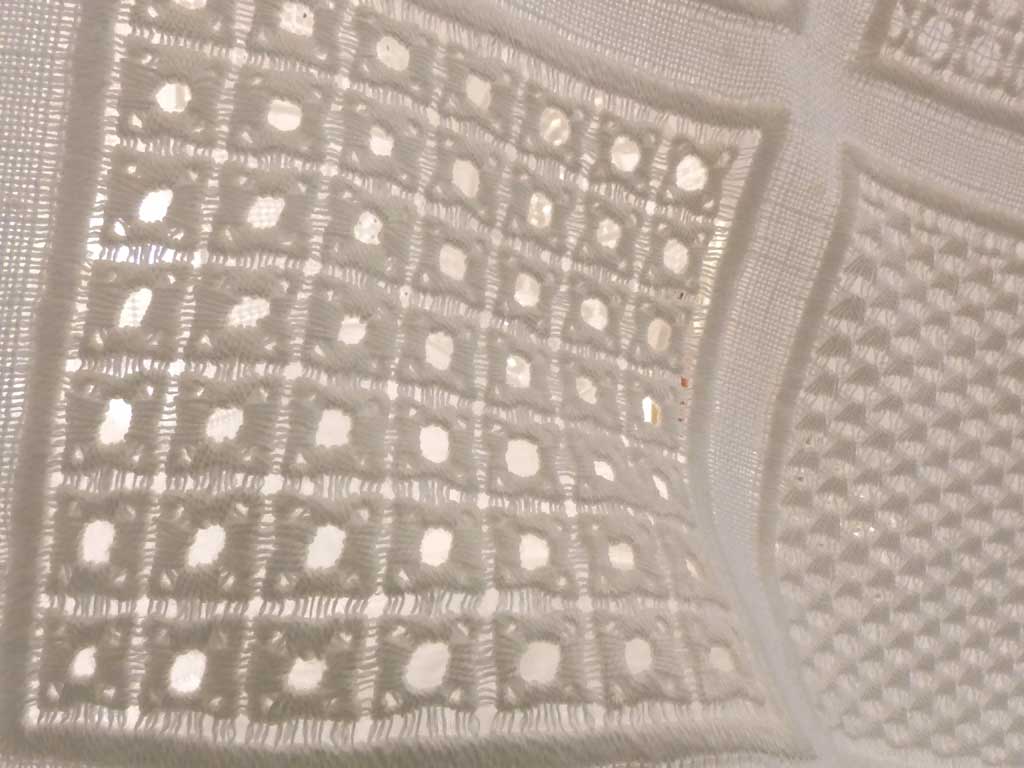
7.  Nelke  -  OEillet  -  Carnation  -  Anjer
Limetrosen II, p. 30.


Cette variation est particulièrement appropriée au remplissage à axe diagonal de Coeurs et de Tulipes en broderie Schwalm.  Elle s'utilise également en liaison avec d'autres variations des livres Limetrosen.


This variation is particularly suitable to a diagonal axis filling of Hearts and Tulipes in Schwalm embroidery.  It may also be used together with other variations from the Limetrosen books.


Deze variatie is bijzonder geschikt voor een diagonale opvulling van Harten en Tulpen in Schwalmborduurwerk.  Ze kan ook samen worden gebruikt met andere variaties uit de Limetrosen boeken.


8.  Wimpernschlag  -  Battement des cils  -  Eyelash blink  -  Wimperknip
Limetrosen II, p. 14.


Remplissage à axe droit pour espaces de taille moyenne.


Rectilinear axis filling destined for medium sized fields.


Rechtlijnige vulling bestemd voor middelgrote vlakken.


9.  Blümchen mit Lücke  -  Fleurette avec jour  -  Openwork flower  -  Opengewerkt bloempje
Limetrosen I, p. 12.


Ce motif est conçu pour remplir des espaces, même circulaires, de petite et moyenne taille.


This motif has been designed to fill small and medium sized, even circular, areas.


Dit motief is ontworpen voor de vulling van kleine en middelgrote, zelfs cirkelvormige, vlakken.


10.  Grosser Flechter  -  Tresses épaisses  -  Thick braids  -  Dikke vlechten
Limetrosen II, p. 36.


Dans cette variation du point d'oeillet c'est l'empoignement des parties individuelles du motif qui crée une structure de tressage.


The interlocking individual parts of the motif create a braid structure in this variation on the eyelet stitch.


Het ineengrijpen van de afzonderlijke onderdelen van het motief creëert een vlechtwerkstructuur in deze variatie op de madeiraster.


A suivre....           To be continued....               Wordt vervolgd....


__________________________________________


NEWSLETTER
Ne manquez surtout pas de confirmer votre inscription à ma Newsletter en cliquant sur le lien que vous recevez par courriel automatique instantanément après inscription.  Faute de confirmation, votre inscription reste sans aucun effet.
Cliquez sur le lien ci-dessous pour de plus amples informations :

Please don't fail to confirm your subscription to my Newsletter by clicking the link you receive by automatic e-mail after subscription.  In the absence of confirmation your subscription remains without any effect.
Click on the link below for more information :

Laat vooral niet na uw inschrijving op mijn Newsletter te bevestigen door te klikken op de link die u per automatische e-mail ontvangt onmiddellijk na inschrijving.  Bij gebrek aan confirmatie blijft uw inschrijving immers zonder enig effect.
Klik op onderstaande link voor meer uitleg :


vendredi 16 octobre 2015

SCHWALM - Sampler - Luzine Happel (1/7)


A l'occasion de la présentation de mon premier sampler (marquoir) de broderie Schwalm, en avril 2014, j'ai fait mention d'un deuxième, plus grand, qui était en route.  Le voici donc bien fini !

At the introduction of my first Schwalm sampler, in April 2014, I mentioned another one, much bigger, I was working on.  Now here it is, finally finished !

Bij de publicatie van mijn eerste Schwalm sampler, in april 2014, maakte ik melding van een nog groter project dat ik had aangevangen.  Hier is het dan, helemaal af !


Du point de vue technique, ce sampler est composé de 35 cases disposées d'une manière équilibrée par 7 rangées de 5 cases chacune.  Tracée au passé plat, chaque case, mesurant 10 sur 10 cm, a été remplie d'une variation sur le point d'oeillet (ou rosette).  L'ensemble est entouré d'un cadre de 75 sur 50 cm, exécuté au point carré.


From a technical point of view this sampler is composed of 35 squares, evenly disposed in 7 rows of 5 squares each.  Drawn in satin stitch and measuring 10 by 10 cm each square has been filled with a variation on the eyelet stitch.  The whole is surrounded by a frame of 75 by 50 cm, executed in square stitch.


Vanuit technisch oogpunt bekeken is deze sampler samengesteld uit 35 vakjes, evenwichtig opgesteld in 7 rijen van telkens 5 vakjes van 10 op 10 cm.  Deze zijn afgebakend in platsteek en allemaal opgevuld met een verschillende variatie op de madeiraster.  Het geheel is omringd met een kader van 75 op 50 cm in hokjessteek.


L'inspiration, la technique et les modèles pour ce sampler sont tirés des livres Limetrosen I et II de la créatrice allemande Luzine Happel, la spécialiste par excellence de la broderie Schwalm.  Ces deux tomes présentent quelque 150 remplissages utilisés dans la broderie Schwalm.
Pour de plus amples informations sur Luzine Happel, ses ouvrages, ses livres et son exposition permanente, je me réfère à mon article du 4 avril 2014 et au site internet de la créatrice.

Inspiration, technique and patterns of this sampler were found in the books Limetrosen I and II by the German designer Luzine Happel, the most outstanding expert in Schwalm embroidery.  These two volumes supply some 150 fillings that can all be used in Schwalm embroidery.
For more information on Luzine Happel, her embroidery works, books and permanent exhibition I refer to my post of 4 April 2014 and to the designer's website.

Inspiratie, techniek en modellen van deze sampler komen uit de boeken Limetrosen I en II van de Duitse ontwerpster Luzine Happel, de specialiste bij uitstek in Schwalmborduurwerk.  Deze twee boekdelen bieden een 150-tal vullingen die alle in Schwalmborduurwerk kunnen worden gebruikt.
Voor meer informatie over Luzine Happel, haar borduurwerk, haar boeken en haar permanente tentoonstelling verwijs ik naar mijn artikel van 4 april 2014 en de website van de ontwerpster.


Ce projet a été un compagnon fidèle durant trois ans.  Pendant mes déplacements en TGV surtout, mon sampler m'a aidé à faire passer le temps de façon agréable, chaque case étant différente et offrant un nouveau plaisir.  Cependant, comme chaque sampler, celui-ci aussi demandait une préparation assez importante : le mesurage, la disposition et le traçage au passé plat des cases, la broderie du cadre.
J'avais choisi pour mon sampler du lin français Gander 14 fils : une toile parfaitement régulière, mais qui malheureusement s'est révélée un peu trop lâche pour ce genre de travail, quoique cela puisse produire des effets intéressants.  Ce serait pour une nappe de table, que je prendrais un lin au tissage plus dense.
Lorsque la broderie Schwalm est généralement exécutée en coton à broder, moi par contre, j'ai puisé dans mon stock et utilisé DMC perlé 8 et 12, blanc.


This project has been a faithful companion for three years.  Especially during TGV trips my sampler helped me pass the time in a pleasant way, each square being different and offering new pleasure.  However, as all samplers do, this one too required a sizeable preparation : the measuring, the disposition and drawing of the squares in satin stitch, the embroidery of the frame.
I had chosen 35 count French Gander linen : a very regular canvas which unfortunately proved to be a bit too loose for this kind of work, but which, on the other hand, produced interesting effects .  If I choose to make a table-cloth I should go for a more densely woven linen.
While Schwalm embroidery is usually executed in coton à broder, I myself delved into my stock and used DMC perlé 8 and 12, white.


Deze sampler was een trouwe metgezel gedurende een drietal jaren.  Vooral tijdens mijn verplaatsingen per TGV hielp hij mij de tijd aangenaam doorbrengen, want elk vakje was verschillend en het bleef dus boeiend.  Nochtans, zoals dit bij elke sampler het geval is, mag het voorbereidend werk niet worden onderschat : het opmeten, de opstelling en het afbakenen in platsteek van de vakjes, het borduren van het kader.
Als stof voor mijn sampler had ik 14 draads Frans Gander linnen gekozen : een perfect regelmatig geweven linnen dat echter wat te losjes bleek voor dit soort werk, hoewel het interessante effecten teweeg bracht.  Maar mocht het voor een tafelkleed bestemd zijn, dan koos ik toch maar een wat dichter geweven stof.
Hoewel Schwalmborduurwerk in de regel met coton à broder wordt uitgevoerd, heb ik uit mijn voorraad geput en mijn sampler met DMC perlé 8 en 12, wit geborduurd.


Je consacrerai à chaque rangée un article, dans lequel les 5 cases seront présentées une par une avec leur nom, un commentaire sommaire et illustrées de quelques photos.
Quant à l'exécution technique des points, je me réfère aux livres de Luzine Happel ; livres très instructifs du reste et procurant toute information nécessaire.  Le texte original des deux livres est en allemand, mais il existe une version française de Limetrosen II.  Par contre, un encart avec la traduction française est disponible de Limetrosen I.  J'indiquerai donc aussi dans quel livre (Limetrosen I ou Limetrosen II) et à quelle page se trouve chaque remplissage.
Voilà, c'est parti !...

Each row of my sampler will be dealt with in a separate article, in which the 5 squares will be presented one by one with their name, a summary comment and illustrated with some photographs.
As for the technical execution of the stitches I refer to Luzine Happel's books, in which all necessary information can be found.  Both of the books are in German, but a supplementary sheet with an English or French translation of the text is available for Limetrosen I.  Only Limetrosen II has a Franch version too.  I shall therefore also mention in what book (Limetrosen I or Limetrosen II) and on what page each square of my sampler can be found.
So, here we go !...

Aan elke rij van mijn sampler zal ik een apart artikel wijden, waarin telkens de 5 vakjes een voor een aan bod zullen komen met hun naam, een summier commentaar en geïllustreerd met enkele foto's.
Voor wat de technische uitvoering van de steken betreft verwijs ik naar Luzine Happels boeken, die instructief zijn opgesteld en alle nodige informatie bevatten.  Beide boeken zijn in het Duits, maar van Limetrosen I is een bijlage met Franse en Engelse vertaling van de tekst beschikbaar.  Alleen Limetrosen II is ook in Franse versie uitgegeven.  Van elke variatie zal ik dus ook het boek (Limetrosen I of Limetrosen II) en de bladzijde vermelden waar die is te vinden.
Hier gaan we dan !...

1.  Teddybär  -  Nounours  -  Teddy Bear  -  Teddybeer
Se trouve dans le livre Limetrosen I à la page 24.


Cette variation sur le point d'oeillet, appelée Nounours, est particulièrement appropriée à un remplissage à axe droit d'un espace de taille moyenne.


Can be found in the book Limetrosen I on page 24. 
This variation on the eyelet stitch, called Teddy Bear, is particularly suitable to rectilinear axis filling of medium sized areas.


Komt uit het boek Limetrosen I op bladzijde 24.
Deze variatie op de madeiraster, Teddybeer genaamd, is bijzonder geschikt voor een rechtlijnige vulling van middelgrote vlakken.


2.  Pfauenauge  -  Oeil de paon  -  Peacock eye  -  Pauwenoog
 Limetrosen I, p. 40


Remplissage à axe droit destiné aux espaces de taille moyenne.


Rectilinear axis filling destined for medium sized areas.


Rechtlijnige vulling bestemd voor middelgrote vlakken.


3.  Hasenohren  -  Oreille de lièvre  -  Hare's ear  -  Hazenoor
 Limetrosen I, p. 44.


Variation de point d'oeillet à axe droit pour remplir des zones de petite à moyenne taille.


Rectilinear axis variation of eyelet to fill small to medium sized zones.


Rechtlijnige variatie op madeiraster om kleine of middelgrote zones op te vullen.


4.  Netzpatent  -  Passe-partout en filet  -  Network patch  -  Netwerk passe-partout
 Limetrosen I, p. 64.


Remplissage à axe droit.


Rectilinear axis filling.


Rechtlijnige vulling.


5.  Lebkuchen  -  Pain d'épice  -  Gingerbread  -  Peperkoek
 Limetrosen II, p. 75.


Cette variation sur le point d'oeillet se prête de préférence à un remplissage à axe droit ou diagonal d'un espace de grande taille.


This variation on the eyelet stitch lends itself to a recilinear and diagonal axis filling of large sized areas.


Deze variatie op de madeiraster leent zich bijzonder wel voor een rechtlijnige en diagonale vulling van grote vlakken.

A suivre...        To be continued...        Wordt vervolgd...

Related Posts Plugin for WordPress, Blogger...