vendredi 30 octobre 2015

SCHWALM - Sampler - Luzine Happel (2/7)


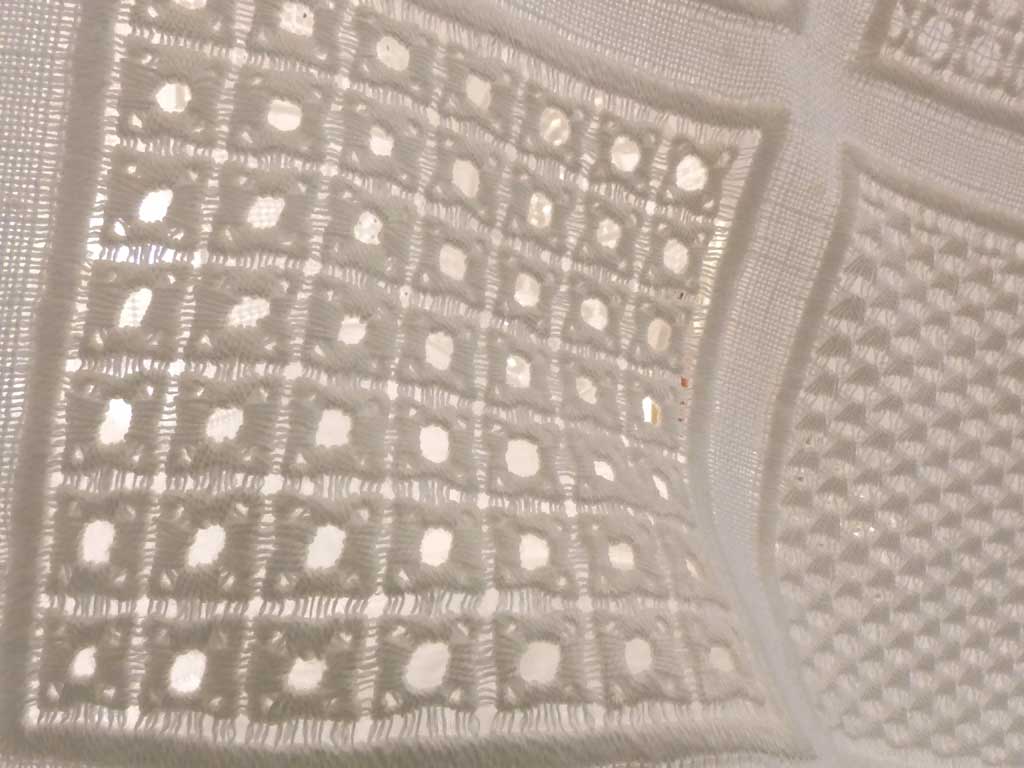
Après l'introduction dans mon article précédent, je vous propose maintenant de regarder de plus près la deuxième rangée de mon sampler de Schwalm que j'ai brodé d'après les livres Limetrosen I et II de la créatrice allemande Luzine Happel.

After the introduction in my previous post we take a closer look now at the second row of my Schwalm sampler that I embroidered from Luzine Happel's books Limetrosen I and II.

Na de introductie in mijn vorig artikel bekijken we deze keer van dichtbij de tweede rij van mijn Schwalm sampler die ik heb geborduurd naar Luzine Happels boeken Limetrosen I en II.


6.  Hahnentritt  -  Pied de poule  -  Cock's foot  -  Hanenpoot
Limetrosen I, p. 35.


Une variation du point d'oeillet qui se prête de préférence à un remplissage à axe diagonal d'espaces de grande taille.


A variation of the eyelet stitch to be used preferably for a diagonal axis filling of large sized areas.


Een variatie op de madeiraster die zich bij voorkeur leent tot diagonale vulling van grote vlakken.


7.  Nelke  -  OEillet  -  Carnation  -  Anjer
Limetrosen II, p. 30.


Cette variation est particulièrement appropriée au remplissage à axe diagonal de Coeurs et de Tulipes en broderie Schwalm.  Elle s'utilise également en liaison avec d'autres variations des livres Limetrosen.


This variation is particularly suitable to a diagonal axis filling of Hearts and Tulipes in Schwalm embroidery.  It may also be used together with other variations from the Limetrosen books.


Deze variatie is bijzonder geschikt voor een diagonale opvulling van Harten en Tulpen in Schwalmborduurwerk.  Ze kan ook samen worden gebruikt met andere variaties uit de Limetrosen boeken.


8.  Wimpernschlag  -  Battement des cils  -  Eyelash blink  -  Wimperknip
Limetrosen II, p. 14.


Remplissage à axe droit pour espaces de taille moyenne.


Rectilinear axis filling destined for medium sized fields.


Rechtlijnige vulling bestemd voor middelgrote vlakken.


9.  Blümchen mit Lücke  -  Fleurette avec jour  -  Openwork flower  -  Opengewerkt bloempje
Limetrosen I, p. 12.


Ce motif est conçu pour remplir des espaces, même circulaires, de petite et moyenne taille.


This motif has been designed to fill small and medium sized, even circular, areas.


Dit motief is ontworpen voor de vulling van kleine en middelgrote, zelfs cirkelvormige, vlakken.


10.  Grosser Flechter  -  Tresses épaisses  -  Thick braids  -  Dikke vlechten
Limetrosen II, p. 36.


Dans cette variation du point d'oeillet c'est l'empoignement des parties individuelles du motif qui crée une structure de tressage.


The interlocking individual parts of the motif create a braid structure in this variation on the eyelet stitch.


Het ineengrijpen van de afzonderlijke onderdelen van het motief creëert een vlechtwerkstructuur in deze variatie op de madeiraster.


A suivre....           To be continued....               Wordt vervolgd....


__________________________________________


NEWSLETTER
Ne manquez surtout pas de confirmer votre inscription à ma Newsletter en cliquant sur le lien que vous recevez par courriel automatique instantanément après inscription.  Faute de confirmation, votre inscription reste sans aucun effet.
Cliquez sur le lien ci-dessous pour de plus amples informations :

Please don't fail to confirm your subscription to my Newsletter by clicking the link you receive by automatic e-mail after subscription.  In the absence of confirmation your subscription remains without any effect.
Click on the link below for more information :

Laat vooral niet na uw inschrijving op mijn Newsletter te bevestigen door te klikken op de link die u per automatische e-mail ontvangt onmiddellijk na inschrijving.  Bij gebrek aan confirmatie blijft uw inschrijving immers zonder enig effect.
Klik op onderstaande link voor meer uitleg :


vendredi 16 octobre 2015

SCHWALM - Sampler - Luzine Happel (1/7)


A l'occasion de la présentation de mon premier sampler (marquoir) de broderie Schwalm, en avril 2014, j'ai fait mention d'un deuxième, plus grand, qui était en route.  Le voici donc bien fini !

At the introduction of my first Schwalm sampler, in April 2014, I mentioned another one, much bigger, I was working on.  Now here it is, finally finished !

Bij de publicatie van mijn eerste Schwalm sampler, in april 2014, maakte ik melding van een nog groter project dat ik had aangevangen.  Hier is het dan, helemaal af !


Du point de vue technique, ce sampler est composé de 35 cases disposées d'une manière équilibrée par 7 rangées de 5 cases chacune.  Tracée au passé plat, chaque case, mesurant 10 sur 10 cm, a été remplie d'une variation sur le point d'oeillet (ou rosette).  L'ensemble est entouré d'un cadre de 75 sur 50 cm, exécuté au point carré.


From a technical point of view this sampler is composed of 35 squares, evenly disposed in 7 rows of 5 squares each.  Drawn in satin stitch and measuring 10 by 10 cm each square has been filled with a variation on the eyelet stitch.  The whole is surrounded by a frame of 75 by 50 cm, executed in square stitch.


Vanuit technisch oogpunt bekeken is deze sampler samengesteld uit 35 vakjes, evenwichtig opgesteld in 7 rijen van telkens 5 vakjes van 10 op 10 cm.  Deze zijn afgebakend in platsteek en allemaal opgevuld met een verschillende variatie op de madeiraster.  Het geheel is omringd met een kader van 75 op 50 cm in hokjessteek.


L'inspiration, la technique et les modèles pour ce sampler sont tirés des livres Limetrosen I et II de la créatrice allemande Luzine Happel, la spécialiste par excellence de la broderie Schwalm.  Ces deux tomes présentent quelque 150 remplissages utilisés dans la broderie Schwalm.
Pour de plus amples informations sur Luzine Happel, ses ouvrages, ses livres et son exposition permanente, je me réfère à mon article du 4 avril 2014 et au site internet de la créatrice.

Inspiration, technique and patterns of this sampler were found in the books Limetrosen I and II by the German designer Luzine Happel, the most outstanding expert in Schwalm embroidery.  These two volumes supply some 150 fillings that can all be used in Schwalm embroidery.
For more information on Luzine Happel, her embroidery works, books and permanent exhibition I refer to my post of 4 April 2014 and to the designer's website.

Inspiratie, techniek en modellen van deze sampler komen uit de boeken Limetrosen I en II van de Duitse ontwerpster Luzine Happel, de specialiste bij uitstek in Schwalmborduurwerk.  Deze twee boekdelen bieden een 150-tal vullingen die alle in Schwalmborduurwerk kunnen worden gebruikt.
Voor meer informatie over Luzine Happel, haar borduurwerk, haar boeken en haar permanente tentoonstelling verwijs ik naar mijn artikel van 4 april 2014 en de website van de ontwerpster.


Ce projet a été un compagnon fidèle durant trois ans.  Pendant mes déplacements en TGV surtout, mon sampler m'a aidé à faire passer le temps de façon agréable, chaque case étant différente et offrant un nouveau plaisir.  Cependant, comme chaque sampler, celui-ci aussi demandait une préparation assez importante : le mesurage, la disposition et le traçage au passé plat des cases, la broderie du cadre.
J'avais choisi pour mon sampler du lin français Gander 14 fils : une toile parfaitement régulière, mais qui malheureusement s'est révélée un peu trop lâche pour ce genre de travail, quoique cela puisse produire des effets intéressants.  Ce serait pour une nappe de table, que je prendrais un lin au tissage plus dense.
Lorsque la broderie Schwalm est généralement exécutée en coton à broder, moi par contre, j'ai puisé dans mon stock et utilisé DMC perlé 8 et 12, blanc.


This project has been a faithful companion for three years.  Especially during TGV trips my sampler helped me pass the time in a pleasant way, each square being different and offering new pleasure.  However, as all samplers do, this one too required a sizeable preparation : the measuring, the disposition and drawing of the squares in satin stitch, the embroidery of the frame.
I had chosen 35 count French Gander linen : a very regular canvas which unfortunately proved to be a bit too loose for this kind of work, but which, on the other hand, produced interesting effects .  If I choose to make a table-cloth I should go for a more densely woven linen.
While Schwalm embroidery is usually executed in coton à broder, I myself delved into my stock and used DMC perlé 8 and 12, white.


Deze sampler was een trouwe metgezel gedurende een drietal jaren.  Vooral tijdens mijn verplaatsingen per TGV hielp hij mij de tijd aangenaam doorbrengen, want elk vakje was verschillend en het bleef dus boeiend.  Nochtans, zoals dit bij elke sampler het geval is, mag het voorbereidend werk niet worden onderschat : het opmeten, de opstelling en het afbakenen in platsteek van de vakjes, het borduren van het kader.
Als stof voor mijn sampler had ik 14 draads Frans Gander linnen gekozen : een perfect regelmatig geweven linnen dat echter wat te losjes bleek voor dit soort werk, hoewel het interessante effecten teweeg bracht.  Maar mocht het voor een tafelkleed bestemd zijn, dan koos ik toch maar een wat dichter geweven stof.
Hoewel Schwalmborduurwerk in de regel met coton à broder wordt uitgevoerd, heb ik uit mijn voorraad geput en mijn sampler met DMC perlé 8 en 12, wit geborduurd.


Je consacrerai à chaque rangée un article, dans lequel les 5 cases seront présentées une par une avec leur nom, un commentaire sommaire et illustrées de quelques photos.
Quant à l'exécution technique des points, je me réfère aux livres de Luzine Happel ; livres très instructifs du reste et procurant toute information nécessaire.  Le texte original des deux livres est en allemand, mais il existe une version française de Limetrosen II.  Par contre, un encart avec la traduction française est disponible de Limetrosen I.  J'indiquerai donc aussi dans quel livre (Limetrosen I ou Limetrosen II) et à quelle page se trouve chaque remplissage.
Voilà, c'est parti !...

Each row of my sampler will be dealt with in a separate article, in which the 5 squares will be presented one by one with their name, a summary comment and illustrated with some photographs.
As for the technical execution of the stitches I refer to Luzine Happel's books, in which all necessary information can be found.  Both of the books are in German, but a supplementary sheet with an English or French translation of the text is available for Limetrosen I.  Only Limetrosen II has a Franch version too.  I shall therefore also mention in what book (Limetrosen I or Limetrosen II) and on what page each square of my sampler can be found.
So, here we go !...

Aan elke rij van mijn sampler zal ik een apart artikel wijden, waarin telkens de 5 vakjes een voor een aan bod zullen komen met hun naam, een summier commentaar en geïllustreerd met enkele foto's.
Voor wat de technische uitvoering van de steken betreft verwijs ik naar Luzine Happels boeken, die instructief zijn opgesteld en alle nodige informatie bevatten.  Beide boeken zijn in het Duits, maar van Limetrosen I is een bijlage met Franse en Engelse vertaling van de tekst beschikbaar.  Alleen Limetrosen II is ook in Franse versie uitgegeven.  Van elke variatie zal ik dus ook het boek (Limetrosen I of Limetrosen II) en de bladzijde vermelden waar die is te vinden.
Hier gaan we dan !...

1.  Teddybär  -  Nounours  -  Teddy Bear  -  Teddybeer
Se trouve dans le livre Limetrosen I à la page 24.


Cette variation sur le point d'oeillet, appelée Nounours, est particulièrement appropriée à un remplissage à axe droit d'un espace de taille moyenne.


Can be found in the book Limetrosen I on page 24. 
This variation on the eyelet stitch, called Teddy Bear, is particularly suitable to rectilinear axis filling of medium sized areas.


Komt uit het boek Limetrosen I op bladzijde 24.
Deze variatie op de madeiraster, Teddybeer genaamd, is bijzonder geschikt voor een rechtlijnige vulling van middelgrote vlakken.


2.  Pfauenauge  -  Oeil de paon  -  Peacock eye  -  Pauwenoog
 Limetrosen I, p. 40


Remplissage à axe droit destiné aux espaces de taille moyenne.


Rectilinear axis filling destined for medium sized areas.


Rechtlijnige vulling bestemd voor middelgrote vlakken.


3.  Hasenohren  -  Oreille de lièvre  -  Hare's ear  -  Hazenoor
 Limetrosen I, p. 44.


Variation de point d'oeillet à axe droit pour remplir des zones de petite à moyenne taille.


Rectilinear axis variation of eyelet to fill small to medium sized zones.


Rechtlijnige variatie op madeiraster om kleine of middelgrote zones op te vullen.


4.  Netzpatent  -  Passe-partout en filet  -  Network patch  -  Netwerk passe-partout
 Limetrosen I, p. 64.


Remplissage à axe droit.


Rectilinear axis filling.


Rechtlijnige vulling.


5.  Lebkuchen  -  Pain d'épice  -  Gingerbread  -  Peperkoek
 Limetrosen II, p. 75.


Cette variation sur le point d'oeillet se prête de préférence à un remplissage à axe droit ou diagonal d'un espace de grande taille.


This variation on the eyelet stitch lends itself to a recilinear and diagonal axis filling of large sized areas.


Deze variatie op de madeiraster leent zich bijzonder wel voor een rechtlijnige en diagonale vulling van grote vlakken.

A suivre...        To be continued...        Wordt vervolgd...

mercredi 30 septembre 2015

UKRAINIAN WHITEWORK - BRODERIE BLANCHE UKRAINIENNE


Me revoilà, enfin !  Un été long et chaud, que celui de 2015 !  Il y avait de quoi tirer sa flemme.  D'où ma rentrée tardive.
Les cigales calmées, reprenons donc le fil et l'aiguille pour un exercice d'assouplissement des doigts : question de ne pas trop brusquer les choses et de se faire plaisir.

At last, I am back !  A long hot summer, that summer of 2015 !  Every reason to be lazy.  That's why I start a little late.
Now that the cicadas have calmed down we take up needle and thread again for a finger exercise : so as not to rush anything and just enjoy ourselves.

Eindelijk terug !  Wat een lange hete zomer, die van 2015 !  Alle reden om te luieren en te niksen.  Vandaar mijn verlate terugkeer.
Nu het gesjirp van de cicaden is uitgestorven nemen we naald en draad weer op voor een vingeroefening : kwestie van ons niet te overhaasten en het leuk te houden.


Il y a quelque temps ma fille et son mari m'ont offert un livre sur la broderie blanche ukrainienne : Gay Eaton's Ukrainian Whitework (ISBN 0-476-01493-X).  Ouvrage remarquable, car organisé de façon originale.  L'auteur, Gaynor M. Eaton de la Nouvelle-Zélande, emportée par une vive curiosité mêlée à autant de respect pour les Ukrainiens et Ukrainiennes qui portaient avec joie et fierté leurs vêtements richement brodés, a consacré à chaque personne rencontrée un chapitre particulier dans lequel elle laisse le brodeur ou la brodeuse présenter son propre modèle et, en même temps, raconter sa propre histoire, souvent triste, parfois terrifiante.


Some time ago my daughter and her husband offered me a book about Ukrainian whitework : Gay Eaton's Ukrainian Whitework (ISBN 0-476-01493-X).  It is a remarkable book because of its original arrangement.  The author, Gaynor M. Eaton from New Zealand, filled with a lively curiosity joined to a great respect for the Ukrainian people who wore their richly embroidered clothing with so much joy and pride, dedicated to each interviewee an individual chapter in which she lets the Ukrainian embroiderer present her own model and tell her own story, often sad, sometimes terrifying.


Enige tijd geleden kreeg ik van mijn dochter en haar man een boek cadeau over Oekraïens whitework (wit borduurwerk) : Gay Eaton's Ukrainian Whitework (ISBN 0-476-01493-X).  Een merkwaardig boek, omwille van zijn originele indeling.  De auteur, Gaynor M. Eaton van Nieuw-Zeeland, gedreven door een brandende nieuwsgierigheid gekoppeld aan een even groot respect voor de Oekraïeners die met genoegen en trots hun rijkelijk geborduurde kledij droegen, heeft aan elke betrokken borduurster (en borduurder) een apart hoofdstuk gewijd, waarin deze zelf haar (zijn) model voorstelt en haar (zijn) eigen verhaal vertelt, veelal triest, soms schrikwekkend.


C'est un livre magnifique, abondamment illustré par des photos, dessins et diagrammes.  Afin de me familiariser avec les points j'ai réalisé préalablement quelques petits motifs en les appliquant sur des sachets de lavande.  Puis j'ai choisi le modèle Maria  -chaque modèle dans le livre porte le nom de son brodeur ou brodeuse ukrainien(ne)-  pour la réalisation d'une pochette destinée à ma liseuse.  Histoire de ne pas la laisser prendre froid durant l'hiver qui arrive !


It is a magnificent book, abundantly illustrated with photographs, drawings and diagrams.  In order to familiarize myself with the stitches I previously realized some small motifs applying them on lavernder sachets.  Then I chose Maria's pattern  -each pattern in the book bears the name of its Ukrainian embroiderer-  for the realization of a pouch to keep my e-reader safe, so that it shouldn't suffer from the cold next winter.


Het is een prachtig boek, rijkelijk geïllustreerd met foto's, tekeningen en diagrammen.  Om aan de steken te wennen heb ik eerst wat kleine motiefjes uitgevoerd op geurzakjes.  Pas dan heb ik Maria's model uitgekozen  -elk model in het boek draagt de naam van de Oekraïense borduurster-  voor het vervaardigen van een tasje voor mijn e-reader.  Kwestie van 'm geen kou te laten vatten komende winter !


La plus ancienne broderie ukrainienne subsistante, qui n'est pas de broderie blanche d'ailleurs, remonte au 1er siècle av. J.-C.  Le savoir-faire et l'art dont témoigne cet ouvrage suggèrent une longue tradition culturelle dont les origines se perdent dans les ténèbres d'un passé lointain.
Les sources de la broderie blanche ukrainienne, qui est une technique peu connue dans ce riche ensemble de la broderie ukrainienne, se situent dans l'est de l'Ukraine, autour de Poltava, une ville située sur l'ancienne route commerciale entre la mer Noire, la mer Baltique et la Grèce.  C'était par les mêmes voies commerciales que se transféraient usages et coutumes, les nouvelles et la culture.  C'est là sans doute qu'il faut chercher la raison des incontestables ressemblances entre la broderie ukrainienne, le Lefkare de Chypre et le Hardanger norvégien.
Cependant, si ancienne qu'elle puisse être, la technique de la broderie blanche ukrainienne n'a été introduite en Europe occidentale qu'au 20e siècle, par les publications de Thérèse De Dillmont : D.M.C. Broderies Ajourées sur Toile et Encyclopédie des Ouvrages pour Dames (téléchargeables gratuitement sur les sites Antique Pattern Library et The Project Gutenberg).


The oldest surviving Ukrainian embroidery, which is not a white embroidery actually, goes back to the 1st century BC.  The skill and artistry of this work suggest a long cultural tradition whose sources got lost in the darkness of a distant past.
Ukrainian whitework, which is a little known technique in this rich whole of Ukrainian embroidery, has its origins around Poltava, an East Ukrainian place on the ancient trade route between the Black Sea, the Baltic Sea and Greece.  It was by the same trade routes that customs, news and culture travelled.  It is certainly there that the reason of the undeniable resemblances between Ukrainian embroidery, Lefkara from Cyprus and Norwegian hardanger could be found.
However, as old as Ukrainian whitework might be, it only has been introduced in Western Europe in the early 20th century by the Thérèse De Dillmont publications : D.M.C. Openwork Embroidery and The Complete Encyclopedia of Needlework (free download on Antique Pattern Library and The Project Gutenberg).


Het oudste overblijvende Oekraïense borduurwerk, dat trouwens geen whitework is, dateert van de 1ste eeuw v. Chr.  De vakkundigheid en het kunstenaarstalent waarmee dit werk is uitgevoerd duidt op een lange culturele traditie, waarvan de oorsprong verloren is geraakt in de duisternis van een ver verleden.
De bakermat van Oekraïens whitework, dat als een weinig bekende techniek deel uitmaakt van het rijke geheel van Oekraïens borduurwerk, ligt in de streek van Poltava, een stad op de oude handelsroute tussen de Zwarte Zee, de Baltische Zee en Griekenland.  Het was langs dezelfde handelswegen dat zich ook gebruiken, nieuws en cultuur verplaatsten.  Ongetwijfeld is hier de reden te vinden van de onbetwistbare gelijkenissen tussen Oekraïens borduurwerk, Lefkara uit Cyprus en Noorse hardanger.
Nochtans, hoe oud het ook mag zijn, Oekraïens whitework deed pas zijn intrede in West-Europa in de vroege 20ste eeuw door de publicaties van Thérèse De Dillmont :  D.M.C. Broderies Ajourées sur Toile en Encyclopédie des Ouvrages pour Dames (gratis te downloaden op de websites Antique Pattern Library en The Project Gutenberg).


Malgré son appellation, la broderie blanche ukrainienne est souvent exécutée en couleur.  Ses applications traditionnelles se trouvaient principalement sur les vêtements et le linge de maison.
Pour celles qui aiment le passé plat et la broderie ajourée, il y a de quoi se régaler dans Gay Eaton's Ukrainian Whitework.  Ce livre révèle une source inépuisable de motifs pour coussins, napperons, pochettes, etc.
J'ai effectué ma pochette sur du lin Cachel 11 fils couleur ivoire avec les Ritorto Fiorentino 8 et 12, couleur 338.


Despite its name, Ukrainian whitework is often executed in colour.  Its traditional applications were mainly found on clothing and house linen.
Satin stitch enthousiasts and openwork lovers should get a lot of pleasure from Gay Eaton's Ukrainian Whitework.  This book is an inexhaustible source of patterns for cushions, doilies, pouches, etc.
I embroiderd my e-reader pouch on 28 count ivory Cachel linen with Ritorto Fiorentino 8 and 12, colour 338.


Ondanks de naam wordt Oekraïens whitework vaak in kleur uitgevoerd.  Traditionele toepassingen waren vooral te vinden op kledij en huishoudlinnen.
Liefhebsters van platsteek en ajourwerk kunnen met Gay Eaton's Ukrainian Whitework beslist hun hart ophalen.  Het boek bevat immers een onuitputtelijke bron van motieven voor kussens, sierkleedjes, foedralen, tassen, enz.
Mijn e-reader etui is geborduurd op 11-draads Cachel linnen, met Ritorto Fiorentino nrs. 8 en 12, kleur 338.

______________________________________________

A celles qui aimeraient apprendre le Reticello, je recommande vivement de jeter un coup d'oeil sur le site de Lilian Kok.  Il s'agit d'un blog qui va présenter un cours de reticello, basé sur le livre Il Reticello de Giuliana Buonpadre (édition revue de 2013).  Ce cours en ligne, gratuit et à suivre sans aucun engagement, démarre au mois de septembre et durera tout l'hiver, en fonction du rythme des articles publiés.
Que le texte écrit et les paroles soient en néerlandais ne devrait pas présenter d'insurmontables obstacles, grâce à une abondance de photos et vidéos bien claires et instructives.  Pour vous rendre sur ce blog, cliquez sur le lien suivant : Handwerkcafé Waddinxveen.

To those who would like to learn Reticello embroidery I strongly advise to take a look at Lilian Kok's website.  She will present on her blog a course in reticello that is based on Giuliana Buonpadre's book Il Reticello (revised 2013 edition).  This online course, free and without any engagement, starts in September and will last throughout next winter, according to the rhythm of the posted articles.
That written and verbal text are in Dutch shouldn't present insurmountable obstacles thanks to an abundance of clear and very instructive photos and videos.  To visit Lilian Kok's blog click on this link : Handwerkcafé Waddinxveen.

Zij die Reticello wensen aan te leren kan ik ten zeerste adviseren een kijkje te gaan nemen op de website van Lilian Kok.  Op haar blog loopt een cursus reticello, gebaseerd op het boek Il Reticello van Giuliana Buonpadre (hierziene druk 2013).  Deze gratis online lessen, te volgen zonder enige verbintenis overigens, lopen vanaf september en doorheen de winter, naargelang het ritme van de geposte artikelen.
Geschreven en gesproken woord zijn in het Nederlands en rijkelijk aangevuld met klaar en instructief beeldmateriaal (foto's en video's).  Om Lilian Koks blog te bezoeken, klik op volgende link : Handwerkcafé Waddinxveen.
Related Posts Plugin for WordPress, Blogger...